Economy & opportunity
The Value Jamaica Has Yet to Capture
Operating businesses, new routes into the market and opportunities beyond cultivation make Jamaica’s cannabis industry worth a closer commercial look.
Jamaica’s legal cannabis industry is already generating revenue. The opportunity now is to build more of the businesses that connect growers with customers, turn harvests into finished products and keep a greater share of the income in Jamaica.
There is a commercial base to work from. The Cannabis Licensing Authority put the industry’s value at US$63.5 million in 2025, compared with US$38.9 million in 2024, according to reporting by the Financial Gleaner republished by the Ministry of Industry, Investment and Commerce. The measure includes retail and wholesale activity, fees and taxes. Its methodology was not fully explained, so it should be read as an indicator of activity rather than a measure of GDP.
An individual business provides another view. NUGL, the parent company of Jamaica’s Kaya brand, reported revenue of US$1.258 million for the quarter ending June 2026, up 45.3 per cent from a year earlier, and net income of US$32,329. The group combines cultivation, processing and retail with hospitality, food and beverage and branded experiences. Its results are company-reported and cover that whole business, but they show how several activities can earn income under a Jamaican brand.
For a businessperson considering the industry, the question is where an additional investment, a better product or a more reliable service could turn this existing activity into a sustainable business. The answer will differ for a farmer, a processor, a retailer and a supplier. Each needs customers, a workable cost structure and room to earn a margin.
More businesses behind every sale
The dispensary is the most visible part of the cannabis economy. Behind it are cultivation, manufacturing, testing, packaging, transport, professional services and customer experience. Developing these connections gives more Jamaican businesses a chance to participate in the income generated by a sale.
For cultivation, consistency and dependable volumes help a farmer secure repeat orders. Processing can create products that serve different customers and uses. A manufacturer also needs packaging, quality control, equipment maintenance and distribution. These are commercial roles for people whose experience may come from agriculture, manufacturing, logistics or other established industries.
Canada demonstrates the breadth of that market. Legal non-medical cannabis sales reached C$5.5 billion in the financial year ending March 2025. Products other than dried cannabis accounted for 40.3 per cent of sales. Inhaled extracts alone represented 31.1 per cent, according to Statistics Canada. Its figures also show that individual categories perform differently: inhaled extracts grew, while solid edibles declined.
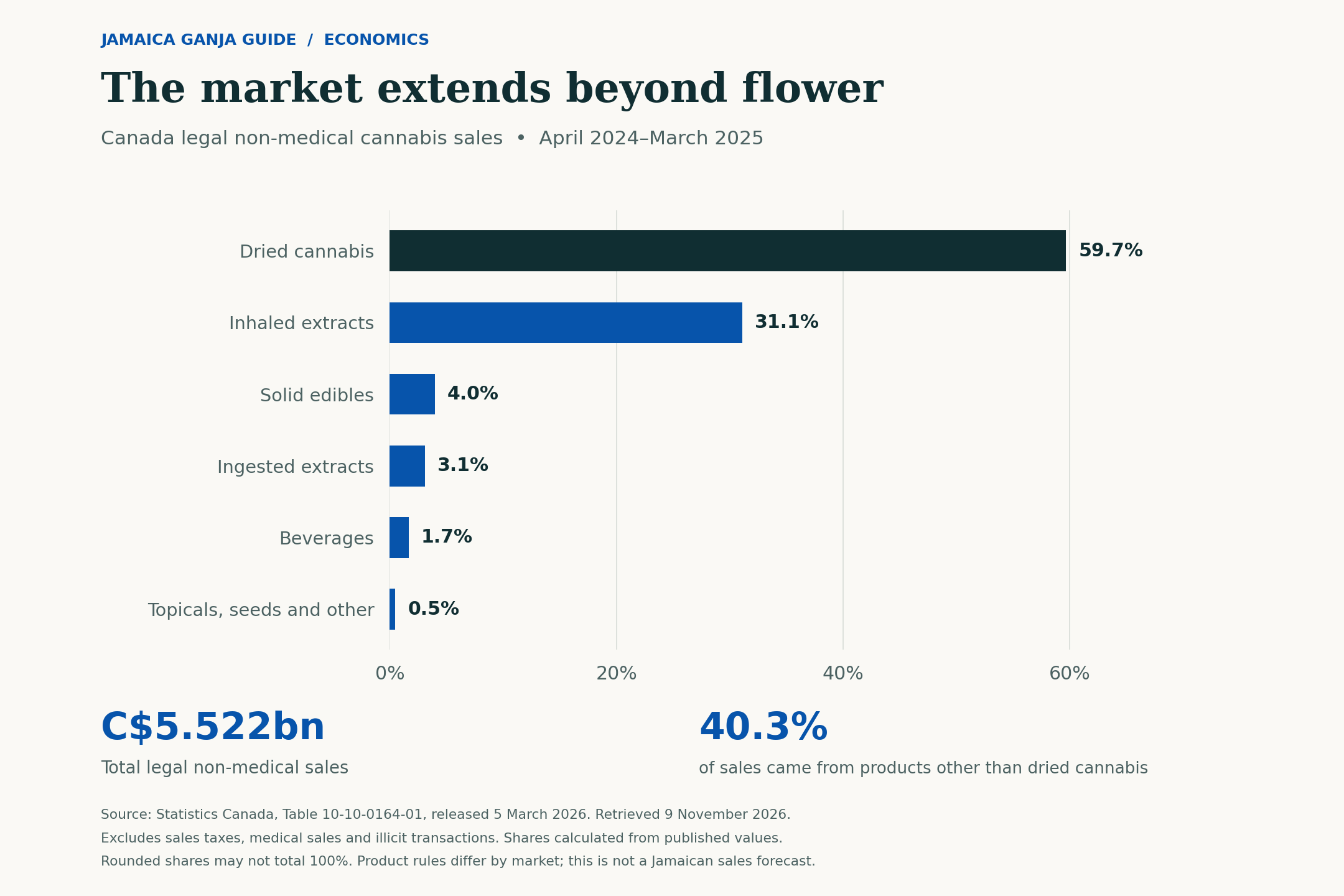
Products other than dried cannabis accounted for 40.3% of Canada’s legal non-medical cannabis sales in 2024/25. Dried cannabis includes pre-rolls. Source: Statistics Canada, Table 10-10-0164-01. Excludes medical and illicit sales and sales taxes. This is not a forecast for Jamaica. View chart at full size.
The useful lesson for Jamaica is the range of businesses that a developed market can sustain. Local demand, prices and product permissions still need to be established for each proposal. Jamaica’s legal framework is for medical, therapeutic and scientific activity, so an overseas product category cannot simply be assumed to have the same market here.
Small enterprises have a place in that wider economy. Of the 3,295 Canadian cannabis retail businesses with employees at the end of 2025, 51.4 per cent employed between one and four people. Those business counts do not establish profitability, but they show that participation is not confined to large corporations.
What is changing in Jamaica
The case for taking a closer look also rests on changes to the conditions under which Jamaican businesses operate.
In April 2026, the CLA launched special permits for traditional and small-scale growers. The community route allows farmers to enter collectively. The transitional route gives participants two years to build capacity towards a full cultivation licence. The Authority said neither permit carries a fee and that participants can access technical support and sell within the licensed market.
Other changes address the day-to-day economics of operating a business. Licence tenure was standardised at three years, and licensees can continue full operations during an approved extension rather than taking a crop only as far as harvest. The Ministry also described changes to security requirements intended to reduce start-up costs, alongside provision for retail delivery. For an eligible operator, continuity, lower entry costs and the ability to reach customers affect the commercial plan directly.
These changes create openings that deserve examination. Their value will depend on whether growers can obtain orders and whether businesses can serve customers profitably. The Ganja Growers and Producers Association made that point when it welcomed the reforms and called for practical financial and technical support and dependable routes to market.
A permit creates a route into the industry. A buyer gives a farmer a reason to plant. Connecting the two is a commercial task that requires organisation, investment and sustained relationships.
Tourism and products with a Jamaican identity
Jamaica also has an opportunity to connect authorised cannabis businesses with its visitor economy. Kaya’s combination of retail, cultivation, hospitality and experiences is one operating example. It shows how a business can develop several customer relationships around a brand rather than relying on a single product.
For others, the question is what a visitor will actually buy, how that customer can be served lawfully and how much of the resulting expenditure goes to Jamaican workers and suppliers. A cannabis purchase during an existing holiday is a sale worth earning. Attributing the visitor’s entire trip to cannabis would overstate the benefit.
Products made in Jamaica offer another avenue. The CLA reported four exports of value-added ganja products in 2025, compared with none in 2024. The shipments included oils, balms and lotions, although their value was not disclosed. That is evidence of an activity beginning to develop, rather than an established export market at scale.
Building on it requires a customer and a product that can compete. Jamaica has an import and export framework, but an overseas business also needs to meet the destination’s requirements and arrange a workable payment route. The commercial starting point is a credible order, not the assumption that international recognition will automatically produce one.
Capital needs a workable business
Banking remains part of the investment question. In August 2026 reporting, senior CLA officials continued to identify access to finance as a concern. An investor needs to understand which accounts, payment services, working capital and financing arrangements a particular business can actually obtain.
The experience of established markets reinforces the need for discipline. Colorado recorded US$1.316 billion in marijuana sales in 2025 and US$236.4 million in state tax and fee receipts. Those are substantial outcomes. Yet sales were well below the US$2.229 billion recorded in 2021. A large market can contract, and revenue alone does not establish a profitable business.
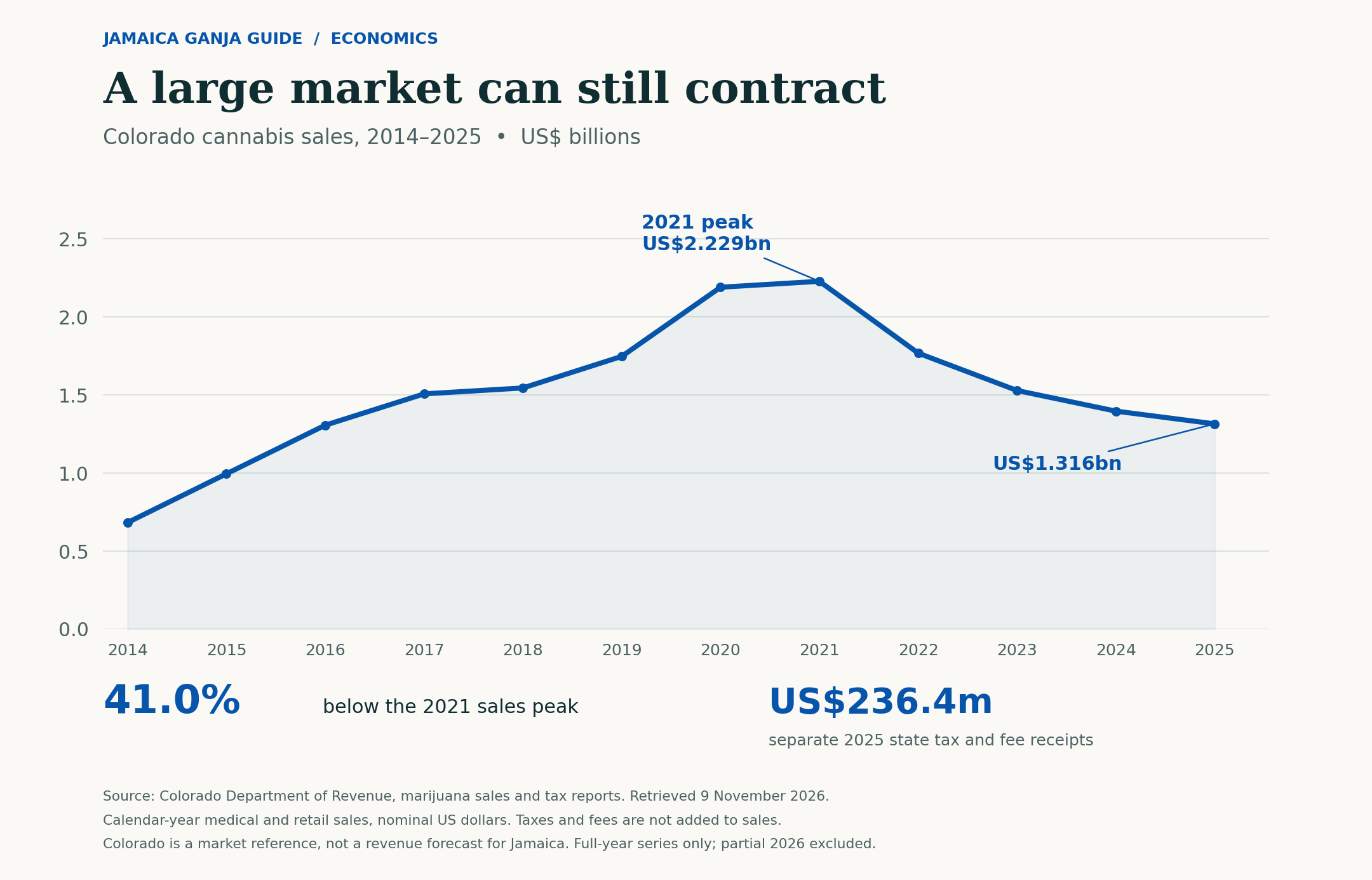
Colorado’s regulated market produced substantial sales and public receipts, but growth did not continue indefinitely. Source: Colorado Department of Revenue sales reports and tax and fee reports. Nominal US dollars. Tax and fee receipts are separate from sales, not a net fiscal benefit. This is not a forecast for Jamaica. View chart at full size.
That experience makes the choice of business model more important. A proposal should show who the customer is, why that customer will buy again, what it costs to supply them and how the business will finance its operations. For Jamaica, these questions should guide investment into the industry as it develops.
An opportunity worth investigating
CanEx began examining the economic opportunity through commissioned research in 2022, engaging Beau Whitney of Whitney Economics to assess domestic and visitor demand, employment, public revenue and wider effects in Jamaica and CARICOM. Whitney’s later February 2024 regional executive summary projected more than 40,000 full-time jobs under expanded adult-use frameworks across CARICOM. That is a conditional regional scenario, rather than a forecast for Jamaica’s current medical industry.
The Jamaican evidence now gives businesspeople something more immediate to examine: operating enterprises, a wider route into the licensed market, emerging value-added activity and practical gaps between producers and customers.
Jamaica has begun building a cannabis economy, but the work of developing its commercial connections is far from complete. Investment in a viable processor, a dependable supply relationship or a service that helps existing operators compete can extend the benefits beyond the business receiving the capital. That can mean repeat orders for farmers, skilled work and more spending with local suppliers.
For an investor assessing new opportunities in Jamaica, cannabis deserves a place on the list. There are functioning businesses to assess and identifiable problems to solve. Jamaica’s reputation can bring attention to the industry. The opportunity is to build enterprises capable of turning that attention into lasting income.
Keep reading
ADVERTISEMENT
A DECADE OF CONNECTIONS


Caribbean Wellness
Conference & Expo
Summit Kingston
Kingston, Jamaica